
What does it actually mean to be at an A2, B1, or B2 level in a foreign language? Can you hold a conversation, study at a university, or work in an international environment? Understanding the different levels of language proficiency helps you answer these questions and set realistic goals for your learning journey.
The Common European Framework of Reference for Languages (CEFR) provides a widely used framework for describing language proficiency, from A1 (Beginner) to C2 (Proficient). Each level represents a different range of communicative abilities, showing what learners can understand and express in everyday, academic, and professional situations.
In this guide, we explore what you can realistically do at each of the six CEFR levels, with examples from personal, public, occupational, and educational settings. You will also learn how language demands change as you progress, helping you understand which level may be suitable for your study plans, career goals, or everyday communication.
Knowing grammar rules and having a broad vocabulary are important parts of learning a language. However, language proficiency also depends on how effectively you can use that knowledge to communicate in real situations. You may understand a written article but struggle to explain its main ideas in a conversation. Similarly, you might speak comfortably about everyday topics but find it difficult to follow a professional discussion.
The CEFR Companion Volume, published by the Council of Europe, takes this practical aspect of language learning into account. It describes language proficiency through four modes of communication and four broad domains of language use.
The CEFR identifies four ways people use language:
These modes often overlap in everyday communication. During a meeting, for instance, you may listen to a colleague’s proposal, respond with your own ideas, and summarise key points to help the group reach a decision.
The CEFR also considers the contexts in which communication takes place:
Your ability may vary across these domains. You could communicate confidently with friends but struggle to explain a technical issue at work. Likewise, understanding everyday conversations does not necessarily mean you can follow an academic lecture with ease.
These distinctions help explain why a CEFR level is a general description of communicative ability, not a guarantee that you can handle every situation equally well. The next section explores what these abilities look like at each level, from A1 to C2.
The six levels of language proficiency in the CEFR describe how effectively and independently you can use a language, from handling basic everyday exchanges to communicating complex ideas with precision. The following examples are based on the Council of Europe’s CEFR descriptors, with practical situations illustrating how these abilities may appear in daily life, education, and work.
Your skills may not develop at the same pace. For example, you might read comfortably at B2 while your speaking ability is closer to B1. The examples below describe typical abilities, not a checklist that every learner must meet in exactly the same way.
At A1, you can understand and use familiar expressions in simple everyday situations. You can introduce yourself, share basic personal information, and ask or answer straightforward questions. Communication is usually brief and depends on the other person speaking slowly and clearly.
What you can do:
What may still be challenging: Following conversations at normal speed, explaining unfamiliar ideas, or responding to unexpected questions without help.
At A2, you can communicate in routine situations involving familiar topics and everyday activities. You can describe your background and immediate surroundings, discuss basic needs, and exchange information in predictable situations. Conversations are more developed than at A1, although you may still need some support.
What you can do:
What may still be challenging: Keeping a conversation going when the subject changes unexpectedly, understanding detailed explanations, or developing an opinion beyond a few simple points.
At B1, you can communicate with reasonable independence in many familiar situations. You can understand the main points of clear speech on familiar topics, describe experiences, explain your opinions, and manage most common situations while travelling. You can also discuss routine work matters and familiar academic subjects.
What you can do:
What may still be challenging: Following fast-moving discussions, understanding unfamiliar technical subjects, or developing detailed arguments in response to several opposing viewpoints.
The CEFR also includes B1+ descriptors for certain communication activities. These represent stronger performance within the B1 range. For example, a learner may be able to explain the main trends in a simple chart while still needing support to interpret more detailed information.
At B2, you can communicate with greater fluency and spontaneity. You can understand the main ideas of complex texts on concrete and abstract topics, including technical discussions within your field. You can also explain your views in detail, develop arguments, and participate more actively in academic and professional discussions.
What you can do:
What may still be challenging: Understanding subtle implications, following highly specialised discussions outside your field, or expressing complex ideas with the precision expected in advanced academic or professional settings.
Some CEFR B2+ descriptors describe stronger performance within this level, such as handling more demanding discussions or presenting detailed information from visual data. This reflects a wider range of ability within B2, rather than a separate main proficiency level.
At C1, you can use the language flexibly and effectively for social, academic, and professional purposes. You can understand long and demanding texts, recognise implied meanings, and express yourself fluently with little obvious effort. You can also adapt your communication to different audiences and situations.
What you can do:
What may still be challenging: Understanding highly specialised material outside your field, unfamiliar accents or language varieties, and expressing very subtle distinctions with complete precision.
At C2, you can understand virtually everything you hear or read with ease. You can summarise information from different spoken and written sources, reconstruct complex arguments, and express yourself spontaneously with a high degree of precision. You can also recognise subtle differences in meaning and adapt your language to demanding situations.
What you can do:
C2 does not mean knowing every specialised term or having the same expertise as a native speaker in every subject. Even highly proficient language users may need to learn the terminology and conventions of an unfamiliar academic or professional field.
The CEFR levels can help you understand your language abilities, but the level you need depends on how you plan to use the language. Studying abroad, working in an international environment, and travelling all involve different communication demands.
The following levels offer general guidance. Actual requirements may vary depending on the university, employer, country, and type of activity.
Studying at a university in another language requires more than everyday conversation. You need to follow lectures, understand academic texts, write assignments, and participate in discussions.
B2 is a useful target for many academic pathways, as it indicates that you can understand complex material and develop arguments with reasonable independence. Some universities and programmes, however, expect C1-level proficiency or specific test scores.
For example, the University of Cambridge’s undergraduate English language requirements normally include an IELTS Academic score of 7.5 overall, with at least 7.0 in each component. The university also states that you should reach a good C1 level in all four CEFR skills before starting at Cambridge. The University of Oxford also sets English language requirements for applicants, with the applicable standard depending on the course. In terms of CEFR, the standard level broadly corresponds to a solid C1, while the higher level courses requires performance above C1.
If you plan to study abroad, check the requirements of your chosen programme rather than relying on a general CEFR recommendation. Pay particular attention to minimum scores for individual language skills.
The language proficiency required for work depends on the role and how much communication it involves. Some positions mainly require understanding instructions and exchanging routine information, while others involve meetings, negotiations, or detailed reporting.
B1 can provide a foundation for routine workplace communication. At this level, you can discuss familiar work tasks, explain straightforward problems, and exchange information about your responsibilities.
B2 is a stronger target for roles involving regular collaboration and independent communication. You can contribute more actively to meetings, explain professional ideas, and discuss possible solutions. Positions involving complex negotiations, leadership, or detailed communication may require C1 or higher.
Requirements also differ between countries. Germany, for example, does not impose a general German-language requirement for every qualified professional work visa or EU Blue Card. However, certain immigration pathways have specific requirements. According to the German government’s Make it in Germany portal, vocational training visa applicants generally need B1 German.
In Singapore, the Ministry of Manpower has stated that there is no general English proficiency requirement for work pass holders. Employers determine the language skills needed for individual positions, as explained in its official parliamentary response.
Before applying for a job abroad, check both the employer’s language expectations and any relevant immigration or professional licensing requirements.
For travel, A2 or B1 can be a practical starting point, depending on how independently you want to communicate.
At A2, you can manage predictable situations such as ordering food, asking for directions, buying tickets, and checking into accommodation. You can also request basic information and explain simple problems.
At B1, you can handle a wider range of situations with greater independence. You can ask follow-up questions, explain unexpected problems, and participate in conversations about familiar topics.
If you plan to live, study, or work abroad for an extended period, stronger proficiency can make everyday communication easier. You may need to understand official information, discuss housing arrangements, communicate with service providers, and build relationships with people around you.
Ultimately, the right level depends on the situations you expect to encounter and how independently you want to handle them.
Before choosing a language course, it is useful to understand your current proficiency level. This helps you identify your strengths, recognise areas that need improvement, and choose a learning path that matches your goals.
A placement test can provide an initial indication of your level. However, a single test score may not reflect all aspects of your communication ability.
A useful language assessment should consider how well you understand and use the language in different situations. Think about your abilities across the four communication modes:
These abilities do not always develop at the same pace. You might read articles comfortably but struggle to contribute to spontaneous conversations. Another learner may speak confidently about everyday topics but find academic writing more difficult.
A comprehensive assessment can help identify these differences and provide a clearer picture of your level of language proficiency.
Find your current language level with Lingua Learn’s Belgium language assessment.
The six main CEFR levels provide a useful structure for measuring language development, but progress does not always happen in clearly separated stages. Learners may demonstrate stronger abilities in some communication activities while continuing to develop others.
The Council of Europe’s framework also includes plus levels, such as A2+, B1+, and B2+. These indicate stronger performance within a main level, sometimes showing characteristics associated with the next level. They are not additional main levels, but help illustrate the range of abilities within the CEFR framework.
This is particularly relevant when progressing from B1 to B2. At B1, you can communicate independently in familiar situations and explain your opinions with straightforward reasons. At B2, you are expected to handle more complex discussions, develop arguments in greater detail, and respond to different viewpoints.
The transition can feel demanding because it involves more than learning additional vocabulary and grammar. You also need to become comfortable handling more complex information and communicating with greater independence.
The CEFR Companion Volume provides descriptors that illustrate these differences across communication activities.
A well-structured language course should give you enough time to practise and strengthen your skills before moving on to more demanding tasks.
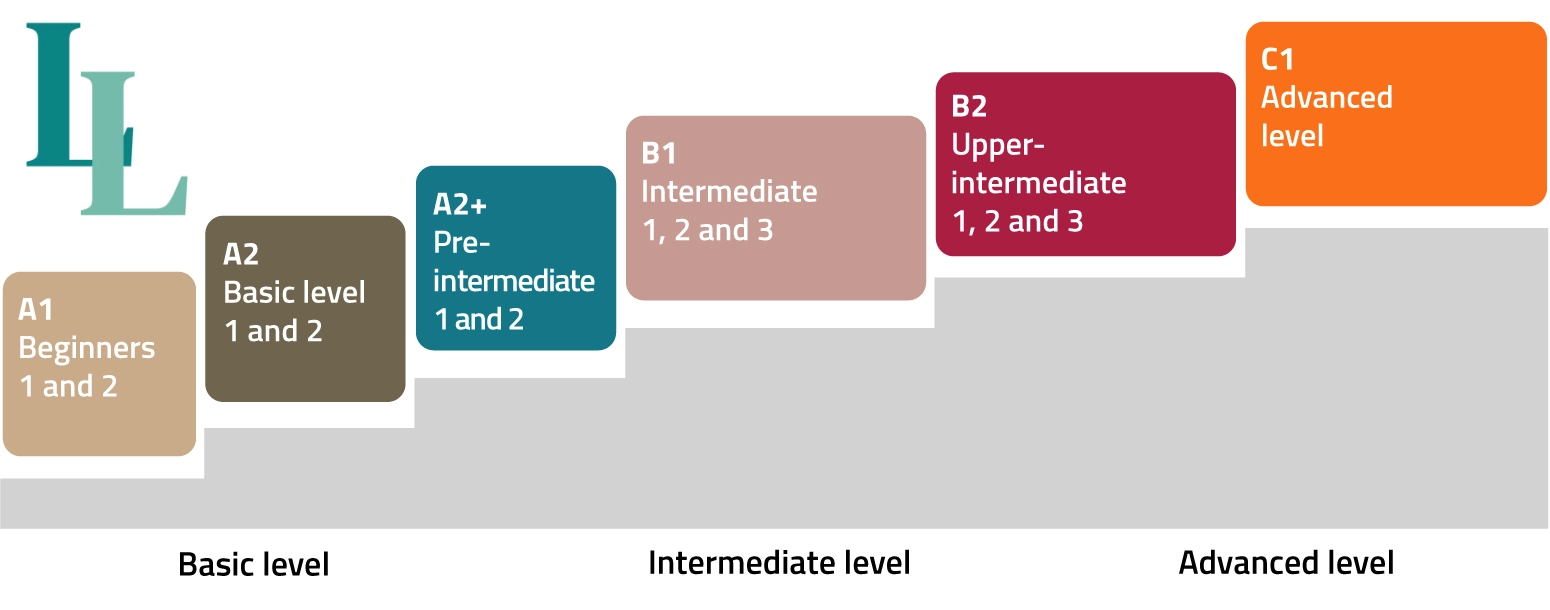
Lingua Learn divides its courses into smaller learning stages within the six main CEFR levels:
These stages are part of Lingua Learn’s curriculum structure, not separate official CEFR levels. They divide the learning journey into smaller steps, allowing learners to consolidate their knowledge and develop their communication skills progressively.
This can be particularly helpful as you move through the intermediate levels, where communication tasks become more complex and require greater independence.
Whether you are learning a language for everyday communication, academic study, or professional development, starting at the appropriate level can make your learning more effective.
Explore Lingua Learn’s Belgium language courses and find a learning path that suits your goals.
Contact our team to learn more about course placement and available learning options.
 En
 Fr
 Nl